
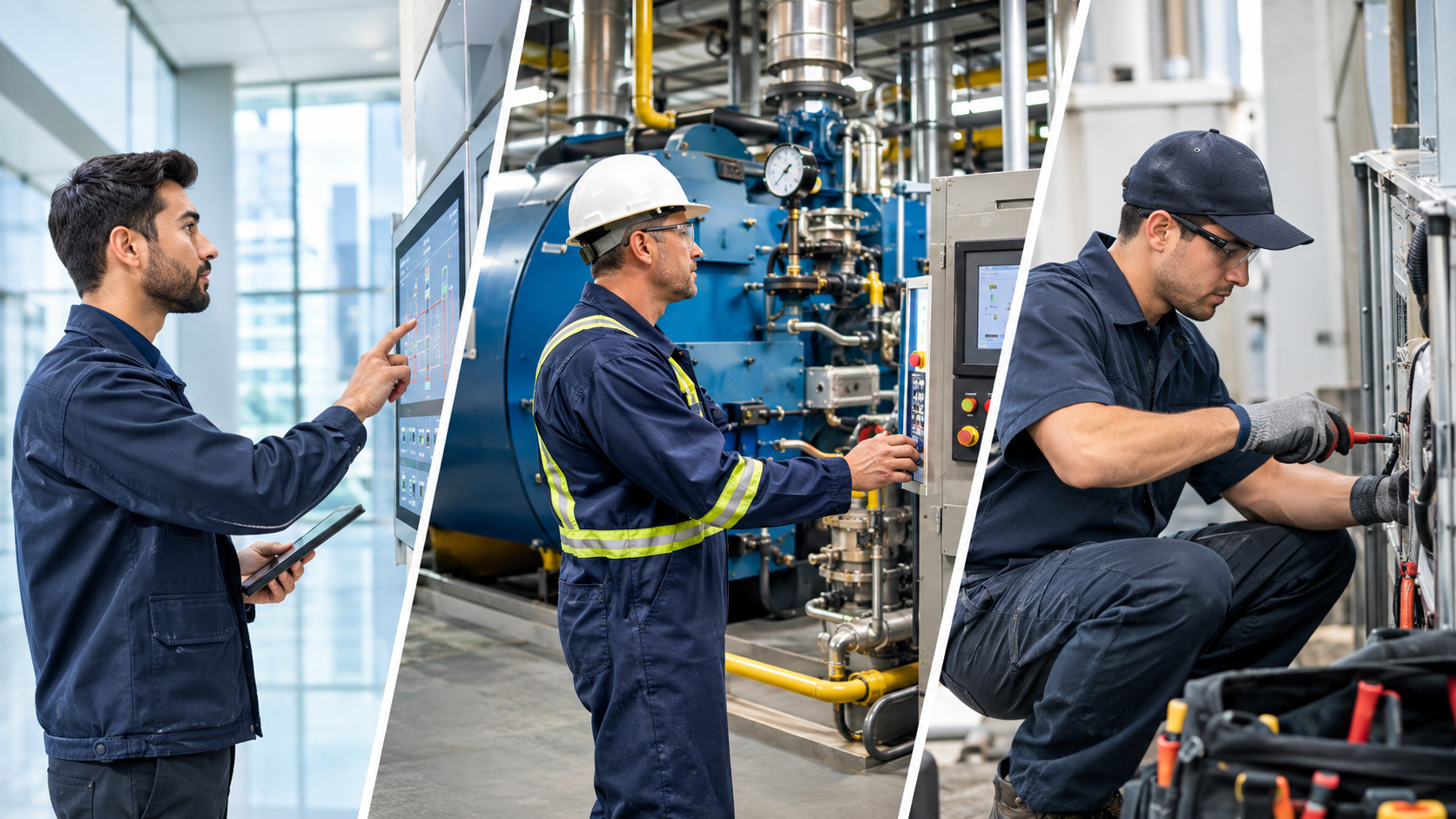
Building Operator vs. Power Engineer vs. Maintenance Technician: What’s the Difference?
In the building operations and facilities management industry, job titles such as Building Operator, Power Engineer, and Maintenance Technician are sometimes used interchangeably. Although these roles can overlap, each has distinct responsibilities, qualifications, and areas of expertise.
Understanding the differences can help property managers, facility owners, and employers identify the right professionals for their staffing needs.
What Is a Building Operator?
Building Operators are commonly employed in commercial and residential properties, including office towers, shopping malls, residential complexes, retail plazas, and institutional facilities.
Their primary responsibility is to oversee the day-to-day operation and maintenance of a building. Typical duties include:
- Monitoring heating, ventilation, and air conditioning (HVAC) systems.
- Performing minor plumbing and electrical maintenance.
- Responding to tenant and occupant service requests.
- Conducting routine inspections and preventive maintenance.
- Monitoring building automation systems and reporting equipment issues.
- Coordinating repairs and supporting the overall safety and comfort of occupants.
Depending on the building’s mechanical systems and regulatory requirements, certain Building Operator positions may also require a Power Engineering certificate. For example, a facility with a regulated boiler plant may require an appropriately certified Power Engineer to operate or supervise specific equipment, in accordance with applicable regulations.
What Is a Power Engineer?
A Power Engineer, also known as a Stationary Engineer or Operating Engineer in some settings, focuses on the safe operation, monitoring, and maintenance of mechanical and pressure equipment.
Power Engineers may work in industrial facilities, manufacturing plants, hospitals, district energy systems, power generation facilities, and commercial buildings with regulated boiler plants.
Their responsibilities may include:
- Operating and monitoring boilers and pressure vessels.
- Maintaining steam and hot-water heating systems.
- Monitoring plant equipment and operating conditions.
- Performing inspections and routine equipment maintenance.
- Identifying operational issues and responding to equipment alarms.
- Maintaining operating records and following applicable safety procedures.
In British Columbia, Power Engineering certification requirements depend on the equipment, plant classification, operating conditions, and applicable regulations. Technical Safety BC oversees relevant safety requirements and certification.
What Is a Maintenance Technician?
Maintenance Technicians focus on keeping equipment, building systems, and facilities in good working condition. Their responsibilities can vary depending on the employer, property type, and technical specialization.
Common duties include:
- Troubleshooting mechanical and electrical issues.
- Performing preventive and corrective maintenance.
- Repairing equipment, fixtures, and building components.
- Inspecting systems to identify potential problems.
- Supporting building improvement and maintenance projects.
- Coordinating with contractors and other technical personnel.
Unlike a Power Engineer, a Maintenance Technician does not necessarily operate regulated boiler plants or require Power Engineering certification. However, specific qualifications, trade credentials, and safety certifications may be necessary depending on the work performed.
Key Differences Between the Three Roles
| Feature | Building Operator | Power Engineer | Maintenance Technician |
| Primary focus | Day-to-day building operations | Safe operation of regulated plants and mechanical equipment | Equipment repairs and preventive maintenance |
| Typical workplace | Offices, residential buildings, malls, and retail plazas | Industrial plants, boiler plants, hospitals, and district energy facilities | Commercial, residential, industrial, and institutional facilities |
| Common duties | Building inspections, HVAC monitoring, tenant requests, and general upkeep | Boiler operation, plant monitoring, pressure equipment, and operating records | Troubleshooting, repairs, equipment servicing, and maintenance |
| Certification | Depends on the position and site requirements | Required certification depends on applicable regulations and plant classification | Depends on the job duties, trade, and employer requirements |
| Potential overlap | May perform general maintenance and operate building systems | May handle plant operations and related maintenance | May support building systems and assist with mechanical maintenance |
Where Do These Roles Overlap?
In practice, the responsibilities of these professionals often overlap, particularly in commercial and institutional facilities.
For example, a large office tower or hospital may employ a Building Operator who also holds a 4th Class Power Engineering certificate. This combination can be valuable because the employee may be responsible for general building operations while also being qualified to perform duties involving the facility’s regulated mechanical equipment, subject to applicable requirements.
Similarly, a Maintenance Technician may support a Building Operator by handling repairs, troubleshooting equipment, and completing preventive maintenance tasks.
However, job titles alone do not determine whether an individual is qualified to perform regulated work. Employers should assess the equipment involved, the actual duties, the required certification, and the applicable safety regulations before assigning responsibilities.
Which Professional Does Your Facility Need?
Choosing the right professional depends on the facility’s operating requirements.
- Building Operator: Ideal for day-to-day building operations, occupant support, HVAC monitoring, and general facility upkeep.
- Power Engineer: Appropriate where qualified personnel are required to operate or supervise regulated boiler plants and other applicable equipment.
- Maintenance Technician: Suitable for equipment servicing, troubleshooting, repairs, and preventive maintenance.
Some facilities may need a combination of these professionals to ensure smooth operations, reliable maintenance, and appropriate regulatory compliance.
Finding the Right Staffing Support
Finding qualified professionals at the right time can be challenging, particularly when a facility needs vacation coverage, shift replacements, or short-notice staffing support.
Hirethru Employment Solutions Ltd. supports property management companies and facilities by providing Building Operators and Power Engineers for temporary, contract-based, and other staffing needs.
Whether you require a certified Power Engineer to cover a scheduled shift or a Building Operator to support daily facility operations, having access to experienced and appropriately qualified personnel can help maintain continuity.
Contact Hirethru Employment Solutions to discuss your building operations and Power Engineering staffing requirements.


Leave a Reply